
English
Views: 50 Author: MBH Publish Time: 2026-06-03 Origin: Marbach Official


In the world of high-performance engineering plastics, the debate between ULTEM (PEI) and PEEK comes up all the time. Engineers, product designers, and procurement teams constantly ask: Which material is really the best high-temperature plastic for demanding applications?
With 15 years running our specialty plastics factory — including 12 years specifically extruding imported ULTEM and PEEK every week — we've gained real-world insights that go far beyond datasheet numbers.In this detailed guide, we break down the ULTEM vs PEEK comparison to help you make the smartest choice for your project — whether you need extreme heat resistance, cost efficiency, or the perfect balance of both.
What Are ULTEM and PEEK Anyway?
Let's start with the basics.
ULTEM (Polyetherimide – PEI) is an amorphous high-temperature thermoplastic. Produced by SABIC, it's famous for its amber transparency in natural form, excellent dimensional stability, and strong electrical insulation properties. Because it's amorphous, it flows well and is generally easier to process.
PEEK (Polyether Ether Ketone) is a semi-crystalline thermoplastic, best known through the Victrex brand. Its crystalline structure gives it outstanding thermal and mechanical performance, even under continuous high heat and harsh chemical exposure.
From our extrusion floor experience, these molecular differences matter a lot. ULTEM tends to be more forgiving during manufacturing, while PEEK rewards you with superior long-term durability when the going gets tough.
High-Temperature Performance: The Core Battle
When people search for "best high temperature plastic," heat resistance is usually the #1 concern. Here's how they stack up:
Property | ULTEM (PEI) | PEEK | Winner |
Continuous Service Temperature | ≈170°C (340°F) | ≈260°C (500°F) | PEEK |
Glass Transition Temperature | ≈217°C | ≈143–150°C | ULTEM |
Heat Deflection Temperature | 200–210°C | 230–315°C (filled grades) | PEEK |
Short-Term Peak Temperature | ≈200–220°C | 300°C+ | PEEK |
Long-Term Thermal Aging | Good | Excellent | PEEK |
Clear takeaway: If your parts must run continuously above 200°C — think aerospace engine components, oil & gas downhole tools, or automotive turbo systems — PEEK is the undisputed king of high-temperature plastics.
That said, ULTEM performs very well up to 170°C and often gives you 80-90% of the performance at a much friendlier price point. In our 12 years of helping customers, we’ve seen ULTEM shine in medical sterilization trays and aircraft interior parts where temperatures stay moderate but other properties (like flame retardancy) are critical.
Mechanical Strength, Chemical Resistance & More
Mechanical Performance
PEEK generally wins in tensile strength, fatigue resistance, and stiffness at high temperatures. Reinforced grades (glass fiber or carbon fiber) are incredibly robust for structural parts. ULTEM offers solid strength but can show more creep under heavy loads above 180°C.
Wear and Friction
Filled PEEK (with PTFE or carbon) is excellent for bearings, bushings, and sliding components. Because we use imported virgin resin from SABIC and Victrex — rather than recycled or domestic-blend material — our customers consistently report more stable performance and longer service life in demanding applications.
Chemical Resistance
Both are strong, but PEEK handles a wider range of aggressive chemicals and solvents at elevated temperatures.
Flame Retardancy & Safety
Here ULTEM often takes the lead. It offers outstanding UL94 V-0 rating with very low smoke and toxicity — a key reason it’s widely used in aircraft cabins. PEEK is also flame retardant but doesn’t always match ULTEM’s low-smoke performance for interior aerospace specs.
Electrical Properties
ULTEM excels with superior dielectric strength, making it ideal for connectors and insulators in electronics and semiconductor equipment.
Processability & Cost
This is where ULTEM frequently wins for practical projects. It processes at lower temperatures, has better flow, and costs less. Our extrusion team finds ULTEM easier to run with lower scrap rates, which helps keep projects on budget.
Real-World Applications We've Supported
Over the past 12 years, we've extruded both materials for 1,000+ customers worldwide. Here's what we typically recommend:
Choose ULTEM when you need:

Aircraft interior parts and electrical connectors
Medical devices that go through repeated steam autoclave cycles
Semiconductor wafer handling components
Applications needing high transparency or excellent electrical insulation
Projects where cost and easy processing matter
Choose PEEK when you need:
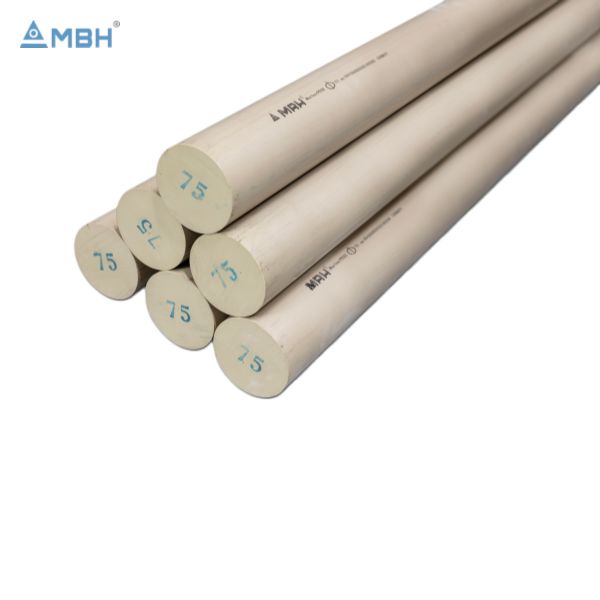
Extreme high-temperature structural parts (aerospace engines, oilfield tools)
High-wear bearings and seals
Medical implants or instruments
Automotive EV battery systems and turbochargers
Long-term reliability in harsh chemical environments
We've helped many clients replace metal parts with ULTEM to cut weight dramatically, and we've guided others to switch to PEEK after ULTEM showed limitations in 200°C+ continuous service.
How to Choose Between ULTEM and PEEK – Practical Guide
Define your real operating conditions — maximum continuous temperature, peak excursions, chemicals, pressure, and mechanical loads.
Check regulatory needs — aviation (FAR), medical biocompatibility, or food contact may push you toward ULTEM.
Calculate total cost of ownership — ULTEM often wins on upfront cost; PEEK may save money long-term through durability.
Test samples — always validate with real conditions. We’re happy to provide test bars from our extrusion lines.
Consider customization — we can compound both materials with glass fiber, carbon fiber, or PTFE to optimize performance.
Final Verdict: Who Is the King?
PEEK is the true king of high-temperature plastics when extreme heat, strength, and longevity are non-negotiable.
However, ULTEM is often the smarter, more practical choice for a huge number of real industrial applications. It delivers excellent performance at a better price and with easier manufacturing.
At our factory, we don't just sell materials — we provide complete specialty plastic application solutions. With 15 years in specialty engineering plastics — and 12 years specifically importing and extruding SABIC ULTEM and Victrex PEEK — we help customers pick the right material, customize it, and get reliable parts faster.
If you’re facing a high-temperature challenge right now, reach out to us. Tell us your temperature range, environment, and performance goals. Our engineers will give you honest recommendations, samples, and competitive pricing tailored to your project.
Whether you ultimately go with ULTEM or PEEK, we’ve got the expertise and production capability to support you from prototype to full-scale production.


